If your site’s little icon vanished from Google’s search results this week, you did not break anything. Google has said the problem is on its end.
The complaints started building on 17 and 18 August 2026 and turned into a wave by the 19th, across the forums and on X. On 21 August, Google’s Rajan Patel, a VP of engineering on Search, replied that it is an issue on their end, that they had identified it, and that they were working on a fix. That is about as clear as bug confirmations from Google get, and it means the correct response for almost every site is to do nothing.
I want to be careful about one thing before going further: the timing sits close to the August 2026 spam update, and people have been connecting the two. The complaints started a couple of days before that update finished rolling out, which is the whole basis for the connection. Nothing Google has said links them. A missing favicon is a rendering detail in the results page, not a ranking signal.
What people were reporting
These are the posts that made this visible, in the order they landed. I am linking to them rather than paraphrasing, because the pattern in them matters more than any single one: different site sizes, different countries, no shared technical fault.
Amit Chauhan, 19 August 2026
Lumdy, 19 August 2026
Cap Puckhaber, 20 August 2026
Google’s first public acknowledgement came on 20 August, and it was two words long:
Rajan Patel, 20 August 2026
The confirmation followed a day later:
Rajan Patel, 21 August 2026
Barry also asked John Mueller about it on Bluesky on 19 August, and reported that one of his broken examples, Backlinko, started working again shortly after he published. So this has been flickering rather than failing cleanly, which is why so many people spent the week refreshing search results and doubting their own eyes.
What I checked myself
Screenshots of search results are weak evidence here, because the icon you see depends on which data centre answered you and when. So I went one layer down and queried the service that supplies those icons directly.
Google serves result favicons from a public endpoint, t3.gstatic.com/faviconV2, with the site URL as a parameter. Ask it for a domain and it returns either that site’s icon or a default grey globe. On 22 August 2026 I asked it for thirteen domains, saved every response, and compared the bytes.
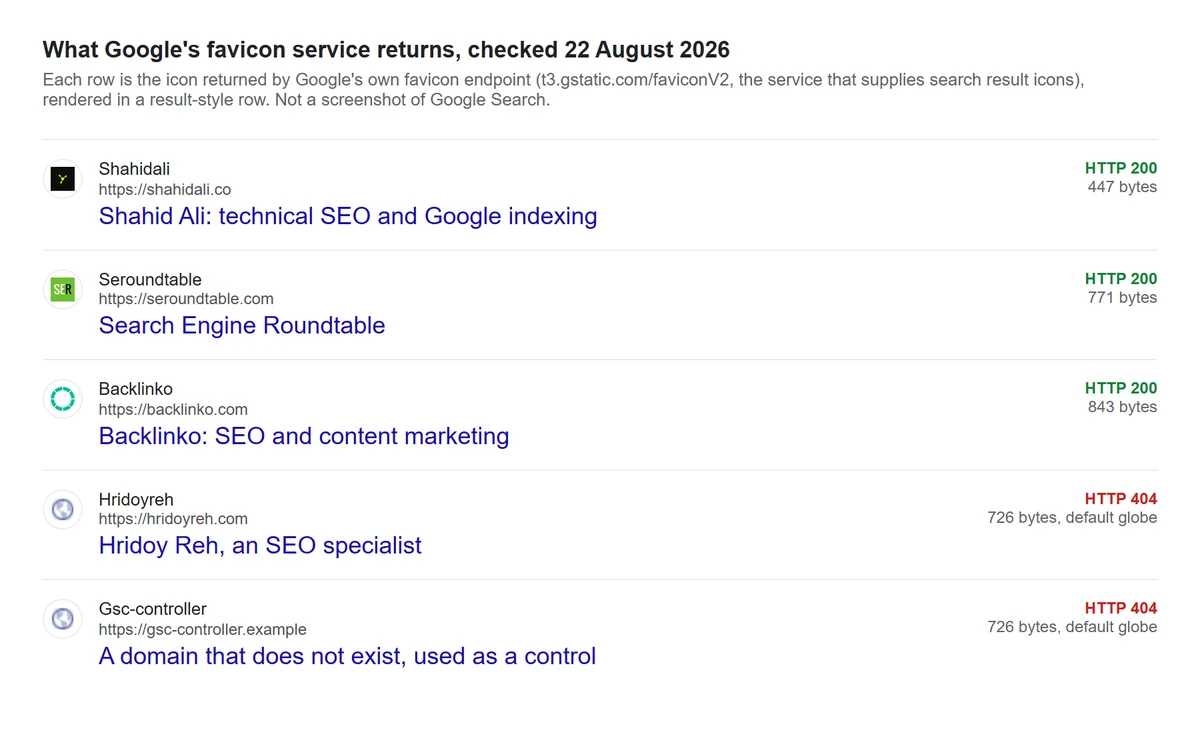
Eleven of the thirteen came back with HTTP 200 and a real icon, including Backlinko, which had been one of the broken examples three days earlier. One domain that had publicly reported losing its icon on 19 August came back HTTP 404 with a 726 byte response. My control, a domain that does not exist at all, came back with a 726 byte response too, and the two files were byte for byte identical: the same default globe. So on the 22nd, at least one reported site still had no icon held for it, while most of the sample was fine.
That is the useful shape of this bug. It is not all sites, it is not one country, and it does not appear to be anything on the affected sites themselves.
What not to do about it
This is the part that costs people real money, so I will be blunt. When something visible breaks in search results, the instinct is to change things until it comes back. During a confirmed platform bug, every change you make is a change you will later have to unpick, and none of them will fix it.
Specifically, do not do these:
- Do not rename or move your favicon file. Google picks up a new favicon when it recrawls your home page, so a rename buys you a recrawl delay on top of the bug you already have. A stable URL is one of the documented requirements.
- Do not request indexing on your home page repeatedly. It does not push the favicon crawler, and the daily quota is worth more elsewhere.
- Do not add half a dozen new icon sizes and manifest entries. If one valid icon was working last week, the markup is not the problem.
- Do not tie it to a ranking theory. If traffic moved in the same week, look at the traffic, separately. See what to do during a Google update for how I separate those.
The one thing worth doing is a five minute check that your side is genuinely clean, so that when the fix rolls out you are not the site that stays broken. Confirm the icon URL loads for anyone, that it is not blocked in robots.txt, that it is square, and that it has stayed at the same URL. Google’s own favicon documentation lists the requirements, including that the file must be crawlable and that changes are picked up on the next home page crawl. If you want to check the same way I did, request the faviconV2 URL for your domain and look at what comes back: a real icon, or the default globe.
Why I am writing this one up at all
Because it is the third reporting oddity in Search in two weeks, after crawl stats going missing for 15 and 16 August, and it lands in the middle of an update rollout. When several things wobble at once, clients ask whether they are connected, and the honest answer needs each one separated and dated. A favicon vanishing is cosmetic. It is also the thing a client notices first, before any chart, because it is the only part of their search listing they can see without logging into anything.
If yours is gone right now, it is Google’s, they know, and it is being fixed. Write the date down, screenshot it, and go and do something that compounds.
One update since: on 21 August Google changed how Googlebot unescapes JSON-LD, which is the opposite kind of story. Not a bug in Google’s reporting, a real change on your side of the wire that no validator flags.
Update, 25 August 2026: fixed, and I re-ran the same check
Google fixed it over the weekend of 22 and 23 August. Rajan Patel said on the Saturday that it was not fixed yet but should be within about twelve hours, and by Sunday evening it was resolved, along with the separate crawl stats gap, which Google backfilled the same weekend.
Rather than take that on trust, I ran the identical check again on 25 August: same endpoint, same method, request the faviconV2 URL for each domain, save the bytes, hash them, and compare every response against a control domain that does not exist.
Every one of the twelve live domains returned HTTP 200 and a real PNG, Backlinko included. The only 726 byte globe in the set came from the nonexistent control domain, which returned HTTP 404, exactly as it should. On the 22nd that same 726 byte response was also coming back for a real, working site. That is the difference between the two runs, and it is the whole story: the endpoint is holding icons again for sites it had lost them for.
Two honest limits on that. The sample is twelve domains I chose, not a survey, so it says the bug is broadly fixed and cannot tell you it is fixed everywhere. And the faviconV2 endpoint is what feeds result favicons, but it is not the search results page itself, so a site could in principle still look wrong in a live SERP snippet while the endpoint reads clean. If yours is still showing the globe in actual search results this week, that is now worth a closer look at your own side, using the five minute checklist above, because the platform-wide explanation has expired.
Which is the real reason to write an update instead of leaving the original post standing. For about a week, “it is Google, they know, do not touch anything” was correct advice, and acting on it saved people from unpicking changes later. From this week it is the wrong advice, and a post that confidently tells you to sit still is actively harmful once the bug is gone. Dated, or deleted, but not left to rot.
Sources
- Rajan Patel on X, it is an issue on our end and being addressed, 21 August 2026
- Google Search Central, Define a favicon to show in search results
- My own check of Google’s faviconV2 endpoint across thirteen domains, 22 August 2026
- My own re-check of the same faviconV2 endpoint across twelve live domains plus a nonexistent control, 25 August 2026
- Rajan Patel on X, follow-up on 22 August 2026 saying a fix was expected within about twelve hours