Giga Indexer alternatives worth naming: IndexJump for a free 100-URL test, SpeedyIndex for the lowest listed price at volume, IndexMeNow for client-billable reporting. For your own pages, Search Console’s free channel beats them all.
Why look past Giga Indexer at all? It sells direct-to-Google URL submission, pay per URL, no subscription, with a dashboard showing Googlebot’s actual visits. On paper it is one of the more transparent products in a category built on vagueness.
Then you compare its homepage to its checkout.
Two price tables, same site, same day
First checked 1 August 2026, and still the case when I captured both pages again on 15 August 2026.
Its homepage lists credit packs as:
| Pack | Credits | Price |
|---|---|---|
| Basic | 60 | $59 |
| Premium | 260 | $199 |
| Business | 600 | $399 |

Its credits page, where you actually buy, lists:
| Pack | Credits | Price |
|---|---|---|
| Basic | 60 | $29 |
| Premium | 260 | $99 |
| Business | 2,000 | $999, shown reduced to $499 |
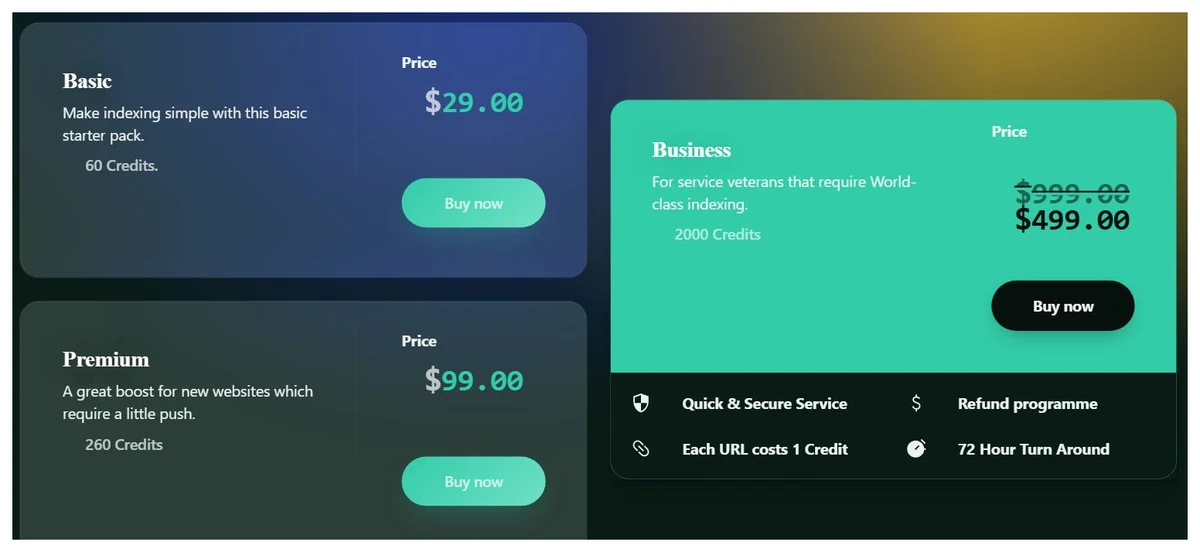
The entry pack is half price at the till. The middle pack is half price at the till. The third tier is not the same product at all: 600 credits on the homepage, 2,000 credits at checkout.
I am not going to tell you what this means, because I do not know. Stale caching, an abandoned migration, or a deliberate anchor are all possible and I cannot see inside the company. What I can tell you is the practical instruction: do not buy from the homepage table. Go to the credits page and read the number there.
There is one more thing worth putting on the record without any claim attached. The homepage prices, 60 credits at $59, 260 at $199 and 600 at $399, are the same credit counts at the same prices as IndexMeNow’s Starter, Premium and Agency packs. Three for three, on both axes. I make no allegation about why, and I have no evidence of a relationship between the two companies. I am telling you because you deserve to know that the “alternative” you are comparing may not be as independent a data point as it looks.
Two more numbers that disagree
On the same homepage:
- “We accept up to 500 URLs per submission, validated against HTTP status before they enter the queue.”
- “Submit 10,000 URLs in a single batch; we’ll process them in under 90 seconds.”
Both cannot be the limit. This is a smaller thing than the pricing, and it is the kind of copy drift that happens when a marketing page gets edited by different hands over time. But it is the second contradiction on the same page, and the second one is when you start reading everything else more slowly.
The uptime figure, 99.94% over 90 days, and the throughput figure, 142 URLs per second peak, are unverifiable from outside. Treat them as marketing until something makes them checkable.
The one claim genuinely worth testing
Here is where Giga Indexer earns real credit. It says every submission records Googlebot’s actual hit against the URL: IP, ASN and timestamp.
That is falsifiable, which almost nothing else in this category is. If you point it at a page on a server whose access logs you control, you can check the log yourself. A genuine Googlebot request resolves to a googlebot.com or google.com host on a reverse DNS lookup, and forward-resolves back to the same IP. Google documents this verification method precisely so publishers can catch crawlers faking the user agent.
So there is an actual experiment available, and it costs $29:
- Buy the smallest pack at the checkout price.
- Run it against pages on a server whose logs you can read.
- Look for the Googlebot hits it reports, and verify them by reverse DNS.
- Then check, two weeks later, whether those pages are actually indexed.
Step four is the one that matters, and it is the step the whole category would prefer you skipped. A crawl is not an index. Googlebot visiting a URL and Google choosing to keep it are different events, and the gap between them is where most indexing money is wasted.
What to use instead
If you want the cheapest test of whether this category works on your links at all, IndexJump gives 100 URLs free with no card. Nothing beats free for a first experiment, and you should be running a control group regardless.
If you want the lowest listed price at volume, SpeedyIndex starts around $0.10 per link and falls to roughly $0.03 at its top tier, against Giga’s $0.48 at checkout entry. Omega Indexer matches that $0.10 and refunds on a 24-hour window.
If you want reporting you can bill to a client, IndexMeNow checks hourly and refunds after 10 days, at roughly double Giga’s checkout price.
If these are your own pages, none of the above. You have Search Console’s free submission channel and no reason to pay a third party for access to your own site. The full market comparison is here.
What all of them share
None of these tools, Giga Indexer included, can make Google keep a URL it has judged not worth keeping. Submission is a request. The index is a decision. Every product in this market sells you the first thing while the marketing implies the second, and the refund policies exist precisely because the vendors know the difference even when the homepage does not spell it out.
If you would rather know why your pages are not indexing than run experiments on credit packs, send me the URL list. The diagnosis is free, and if the honest answer is “your sitemap is fine, save your money”, that is the answer you will get. Where there is real work, indexing work starts at $25 with a per-URL ledger. Check your own list first with the free bulk index checker, or see how this plays out across location pages. If you would rather have an AI assistant pull the statuses than click through a dashboard, the Search Console MCP server exposes index status, unindexed discovery and sitemaps as tools it can call directly. It is open source and pre-alpha, and it needs no API key.
Quick answers
Why does Giga Indexer show different prices in different places?
I do not know, and I am not going to guess at intent. What I can report is what its own pages showed on 1 August 2026: the homepage listed 60 credits at $59 while the checkout at its credits page listed the same 60 credits at $29. Both were live at the same time. Check both yourself before buying, and buy from whichever is cheaper, which is a sentence I should not have to write about a pricing page.
Is the Googlebot hit logging real?
It is the most testable claim in this category, which is already unusual. Giga Indexer says it records Googlebot's actual hit per URL with IP, ASN and timestamp. If you run it against a page on a server whose access logs you can read, you can verify it directly: a real Googlebot visit resolves to a Google IP on reverse DNS lookup. Almost nobody else in this market makes a claim you can check that cleanly.
Do Giga Indexer credits really never expire?
That is what its pricing copy states, and it is a genuine advantage over subscription models where unused allowance vanishes each month. Weigh it against the category's track record: two vendors closed during 2026, and credits that never expire are still worthless if the company does. Do not stockpile.
Is Giga Indexer the same company as IndexMeNow?
I have no evidence of any connection and I am not claiming one. What is verifiable is that the credit tiers advertised on Giga Indexer's homepage, 60 credits at $59, 260 at $199 and 600 at $399, match IndexMeNow's Starter, Premium and Agency packs exactly on both credit count and price. Draw your own conclusion; I am only reporting that the two tables are identical.