There is no best Google indexing tool, because every product in this market is a submission mechanism, and submission only solves discovery. This comparison covers what each service does, what it costs, and the one job none of them do.
Every week someone lands in my inbox having already paid for an indexing tool, sometimes two, with the same pages still sitting out of the index. This is the comparison I wish they had read first, with prices as of July 2026.
I sell manual indexing work, so I have an interest here. I am stating it up front, and I am going to be fair anyway, because half of the people who read this should just use a tool and keep their money.
The short version
Pick by job, not by ranking. For backlinks on sites you do not control, SpeedyIndex and IndexJump are the workable options. For your own healthy site that just publishes a lot, IndexPlease automates the chore. For job and event pages, GetIndexed wraps the API those pages are documented for. And for pages Google has already crawled and declined, no tool on this list moves them, because the problem is the page, not the queue.
| Service | Model | Listed price | Needs GSC access | Where it stops |
|---|---|---|---|---|
| SpeedyIndex | Pay per indexed URL, token system | 100 tokens per indexed link, about $0.10 falling to $0.033 | No | Submission only, no diagnosis |
| IndexMeNow | Pay per indexed URL, credit packs | $59 for 60 credits up to $1,999 for 4,250, excl VAT | No | Submission only, refund only after 10 days |
| Omega Indexer | Monthly credit plans, 1 credit = 1 link | $0.10 per credit on the entry plan, $0.20 top-ups | No | Submission only, refunds at 24 hours |
| Giga Indexer | Credit packs, pay per URL | $29 for 60 credits at checkout; homepage lists $59 | No | Submission only, two conflicting price tables |
| IndexPlease | Subscription, auto-submits from sitemaps | Free tier, paid plans per workspace | Yes, service account | Submission only, no diagnosis |
| Foudroyer | AI SEO suite, auto-indexing is one feature | From $9 per month, 1,000 crawl credits | Yes | Not a link indexer at all |
| GetIndexed | Google Indexing API per project | 200 EUR per project per year | Yes, as owner | Submission only, off-label API |
| GSCTool | Chrome extension automating GSC clicks | $29 per year, $59 lifetime | Yes, your session | Automation only, no diagnosis |
| IndexRusher | Lifetime-deal autopilot submitter | $199 lifetime listed | Yes | 20 Google URLs per day cap, no diagnosis |
| IndexJump | Bot-delivery backlink indexer | 100 URLs free, then packages | No | Submission only, opaque method |
| NeedMyLink | Pay-per-link backlink indexing | From $0.08 per link listed | No | Submission only, serves “gray industries” by its own copy |
| INDEXED.pro | Was an autopilot GSC submitter | Discontinued | Was yes | Shut down in 2026, citing Google’s Indexing API changes |
| Tag Parrot | Was a GSC-connected auto-indexer | Discontinued | Was yes | Closed in 2026, all subscriptions cancelled and refunded |
| Manual service | Human diagnosis, fix, hand submission | From $25 one-time | Yes, as user | Ends when the ledger shows indexed |
The pattern in the last column is the whole article. Read on for the detail, or skip to the one thing none of them fix.
Read this before you buy anything API-based
Any tool whose engine is Google’s Indexing API is standing on ground that moved in 2026, and you should price that in before subscribing.
To be precise, because plenty of pages currently get this wrong: the Indexing API has not been discontinued. It is live and documented today. What changed is that Google narrowed it back to the job it was built for, and started enforcing that.
What it works on now: pages carrying JobPosting structured data, and live video events carrying BroadcastEvent inside a VideoObject. Those are page types that expire, which is why a push channel exists for them at all.
What it does not work on: general websites. Shops, blogs, service sites, category and location pages. If your pages do not carry one of those two schema types, this API is not a faster route into the index, and a tool selling it to you as one is selling a dead mechanism.
The enforcement came in layers. Google’s own documentation now warns that submissions undergo rigorous spam detection and that “the use of multiple accounts or other means to exceed usage quotas” can get access revoked, which is a precise description of how autopilot indexing services are built. Access on the jobs side was gated toward approved partners during 2025. And from late May 2026 there were widespread reports that off-label submissions stopped resulting in crawls at all, with requests still returning 200 OK and still consuming quota while nothing happened. INDEXED.pro, a well-regarded service in exactly this category, now serves a discontinuation notice citing “Google’s recent Indexing API changes”.
The practical rule: if a tool cannot tell you what its engine is, or its engine is the Indexing API used on ordinary pages, treat both the tool and its dashboard’s green ticks as temporary. The full background is in my Indexing API guide.
SpeedyIndex
SpeedyIndex is the biggest name in the link-indexing world. You paste URLs, pay in tokens, and only confirmed-indexed links are charged, with refunds on the rest. It needs no Search Console access at all, which is precisely why the backlink crowd uses it: you cannot add yourself to the Search Console of a site you do not own.
Where it is the right choice: indexing backlinks on pages you do not control. That is its actual market, and for that job a Search Console based service like mine literally cannot compete, because there is no console to open.
Where I would not use it: your own site’s pages. The service describes its method as directing a real mobile Googlebot to your URLs and stays vague past that. For a money site, running opaque third-party crawl mechanics against pages you own is a risk you do not need to take, because you have a first-party channel Google gave you for free.
If you are specifically shopping for a replacement, I broke the options down by use case in SpeedyIndex alternatives.
IndexPlease
IndexPlease watches your sitemaps, finds new and unindexed URLs, and submits them daily on autopilot. Setup means adding their service account to your Search Console and dropping a Bing key at your site root. Of the four, it is the most honest shape: it automates a chore you would otherwise do by hand.
Where it is the right choice: a busy publishing site where new content is fundamentally fine and just needs to enter the queue the moment it goes live. If your pages index on their own and you only want it faster and hands-off, this does that.
Where it falls short: it submits everything it finds, including pages Google has already declined. Those come back stamped “crawled, currently not indexed” no matter how many mornings the bot resubmits them, and the dashboard cannot tell you why.
GetIndexed
GetIndexed sells access to Google’s Indexing API: create a service account, add it as an owner in Search Console, and push up to 200 URLs a day. At 200 EUR per project per year it is priced for agencies, with discounts from five projects up.
Where it is the right choice: honestly, if your pages carry job postings or broadcast events, the API is documented for exactly that, and this is the cleanest wrapper around it. Note that access on the jobs side was narrowed during 2025, so confirm your project still has approved access before you build a process around it.
The caveat that matters: for every other page type this is off-label use, and 2026 is the year that stopped being theoretical. See the warning above: enforcement tightened, off-label submissions were widely reported to stop landing, and at least one established competitor in this category shut down over it. A 200 EUR annual commitment to a mechanism Google is actively policing is a different proposition than it looked like two years ago.
GSCTool
GSCTool is a Chrome extension that automates clicking inside Search Console: bulk URL inspection, bulk removal, bulk indexing requests, across Google, Bing and Yandex. $29 a year, or $59 lifetime, with a $5 day pass.
Where it is the right choice: you are an SEO who already lives inside Search Console, you understand every status you are looking at, and your wrists are tired. It automates your clicks in your session with your judgment still attached.
Where it falls short: it is your judgment or nothing. The extension inspects and submits; deciding what a status means and what to change is still entirely on you. If you have that expertise, fine. If you had it, you would probably not be searching for indexing tools.
If what you mainly want is the checking half, my bulk index checker does inspection through the official API, free, in the browser, with no extension installed.
And if you work inside an AI assistant rather than a browser, the Search Console MCP server hands Claude, or any MCP client, real Search Console tools: index status, unindexed discovery with reason codes, request indexing through your own browser session, plus sitemaps and search analytics. It installs on your own machine as gsc-indexer-mcp, needs no API key and no Google Cloud project, and the source is public. It is pre-alpha, so I would run it alongside the console rather than instead of it for now.
The rest of the market
The four above dominate the search results, but the long tail is worth knowing, mostly for what it teaches.
IndexRusher sells autopilot submission as a lifetime deal, $199 listed at the time of writing. Read the caps before the price convinces you: its own plan sheet allows 20 URLs per day to Google per domain. The Bing and “LLM indexing” numbers are bigger, but if your problem is Google, twenty a day is roughly what a patient human does by hand inside Search Console for free.
IndexJump is a backlink indexer with a free tier of 100 URLs. Its pitch is delivering Googlebot, Bingbot and OpenAI’s crawler to your URLs through “specialized endpoints”, which is the same opaque-mechanics category as SpeedyIndex: it may well trigger a crawl, and it cannot tell you why a crawled page still did not index. Free makes it a reasonable test for backlinks; for your own pages the earlier objections apply unchanged.
NeedMyLink prices per link, from $0.08 listed, with processing up to 10 days. Its own marketing advertises coverage of “over 30 GEOs and niches, including gray industries”, and its packages are denominated in forum links. That tells you exactly which market this serves. If your site is a legitimate business, you are not the customer this was built for, and I would keep your money site’s name out of that pipeline entirely.
IndexMeNow is the biggest name most people meet after SpeedyIndex, and the most expensive thing in this table per URL: $59 for 60 credits at entry, roughly ten times SpeedyIndex’s rate for a near-identical promise. Its page also carries three different timers, a 24 to 48 hour title, an 80%-in-72-hours average, and a refund that only triggers after 10 days. The full breakdown is here, and the head-to-head against SpeedyIndex is here.
Omega Indexer matches SpeedyIndex on price and does one thing better than anyone else in this market: it checks whether a URL is indexable before spending your credit, and refunds non-indexable ones immediately. Most of this category will happily bill you for submitting a 404. More on it, and on what a 24-hour refund window can actually mean, here.
Giga Indexer needs a warning rather than a review. On 1 August 2026 its homepage advertised 60 credits at $59 while its own checkout charged $29 for the same pack, and its third tier was a different product on each page. It also makes the one genuinely testable claim in this category, logging Googlebot hits with IP and timestamp that you can verify against your own server logs. Both halves of that are here.
Indexification is the oldest pitch in the category and the clearest example of paying for volume instead of yield. It sells unlimited submissions, with plans covering up to 1.5 million a month, using bulk pinging, RSS feed generation, social bookmarking and third-party sitemap submissions. Google spent the decade after 2013 learning to identify and discount nearly all of it, and reported real-world rates sit around 40 to 60 percent, which is roughly what those links were going to do on their own. What unlimited actually buys you is here.
IndexBolt is worth reading for one word in its pricing. Its instant tier costs ten credits against standard’s one, roughly $0.45 per URL against $0.045 at the Growth rate, and both tiers promise crawling rather than indexing. Those are two separate decisions, and the second one is the one you are paying to solve. The alternatives, sorted by what you actually need, are here.
Foudroyer is in the table for completeness rather than competition. It is an AI SEO suite from $9 a month where auto-indexing is one bullet beside keyword tracking and site health, and it cannot touch backlinks at all. If you found it while shopping for an indexer, you are probably in the wrong aisle.
INDEXED.pro and Tag Parrot are the cautionary tales, and there are now two of them. INDEXED.pro was a polished autopilot submitter with a real customer base, and it is gone: the site carries a discontinuation notice telling customers the service was shut down “due to Google’s recent Indexing API changes”, subscriptions cancelled. Tag Parrot followed, its pricing page now stating the service is closed, no indexing is available, and every subscription has been cancelled and refunded, again citing recent changes by Google. Every workflow built on either stopped on the same day. That is not a knock on the people who built them. It is what happens, structurally, to any tool whose entire mechanism is a loophole Google tolerates, and two closures in one year is the strongest argument in this whole comparison for owning your indexing process instead of renting it. The full background on that API risk is in my Indexing API guide.
Rapid-Indexer also ranks in these searches with a fastest-on-the-market claim from its own internal tests; its site blocks automated verification, so I have nothing independent to report and it stays out of the table.
The one thing none of them fix
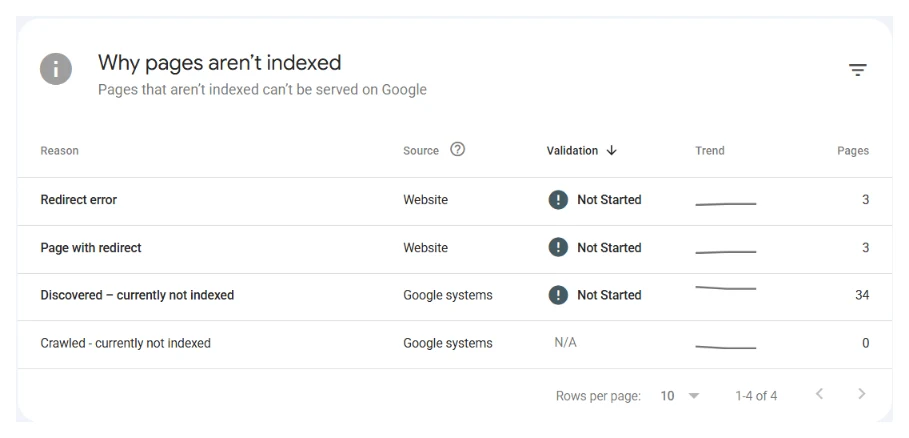
Here is the number that reframes the whole category: on the client sites I have worked across, the large majority of stuck pages were not stuck because Google had missed them. They were stuck because Google had seen them and said no. That is what crawled, currently not indexed means, and it is the most common status in every backlog I open.
Every tool above is a submission mechanism. Submission solves discovery. It does not solve rejection. A page Google declined for thin content, duplicate signals, a stray noindex, or weak internal links will be declined again on resubmission, whether the resubmission came from a token, a sitemap bot, an API call, or an extension. The queue was never the problem.
That diagnosis-then-fix step is the actual job, and it is the job I sell: cause found in plain English, fixed, every URL pushed by hand, and a per-URL ledger so you can watch it happen. If you want a human to look at your specific situation first, the diagnosis is free and sometimes the honest answer is “use IndexPlease, your pages are fine.”
How to choose in one minute
Backlinks on sites you do not control: SpeedyIndex for pay-per-result, IndexJump to test 100 free. A healthy site that publishes constantly: IndexPlease and move on with your life. Job or event pages: GetIndexed, the API is literally for you. An SEO automating their own clicks: GSCTool. Tempted by a lifetime deal: read the INDEXED.pro paragraph again first. Pages that stay unindexed no matter what you submit them with: that is not a submission problem, and a tool is the wrong shape of answer. Start with why pages stay off Google, or send me the list.
Quick answers
Do Google indexing tools actually work?
They work at the one thing they do: telling Google a URL exists. If your page was never discovered, that can be enough. If Google crawled the page and chose not to index it, no amount of resubmission changes the decision, because the reason lives on the page, not in the queue.
Is using the Indexing API for normal pages against Google's guidelines?
Google documents the Indexing API for job posting and broadcast event pages only. Using it for regular pages is off-label. It often works, but you are building on behaviour Google has said it may restrict, and enforcement has tightened before with no warning.
What is the safest way to get pages indexed?
Fix the reason a page is not indexed, then request indexing through Search Console itself. That is the one channel Google explicitly provides for it. It is slower than the tools promise, and it is also the only route with zero guideline risk.
Why are my pages still not indexed after using an indexing tool?
Because the tool submitted a page Google had already seen and declined. That status is a quality or trust decision, and it needs a diagnosis: thin content, weak internal links, duplicate signals, or a technical block. Clear the cause and the page can index; resubmit without clearing it and nothing moves.