For normal pages, no. Google documents the Indexing API for exactly two page types, job postings and livestream video, and since late May 2026 off-label submissions return a 200 OK, spend quota, and trigger no crawl. Use Search Console and your sitemap instead.
Half of the indexing services sold today are a thin wrapper around that one endpoint, and almost nobody using them has either page type. This guide is what I tell clients who ask whether they should be on it.
The short answer
The Google Indexing API is not a general indexing shortcut. Google documents it for two page types only: pages carrying JobPosting structured data, and live video events carrying BroadcastEvent inside a VideoObject. For those it works well. For normal pages it is off-label use, and since late May 2026 reports describe off-label submissions returning 200 OK, consuming quota, and producing no crawl at all. The API itself has not been discontinued; the loophole has. If your pages are ordinary shop, blog, or service pages, fix whatever keeps them out of the index and submit through Search Console instead.
What Google actually says
The Indexing API lets a site notify Google directly when a page is added, updated or removed, instead of waiting for a crawl. Google’s documentation is unambiguous about scope: it is for pages containing a JobPosting or a BroadcastEvent inside a VideoObject, where freshness genuinely cannot wait for normal crawling. A job listing that closed yesterday should leave the index today; that is the problem the API was built for.
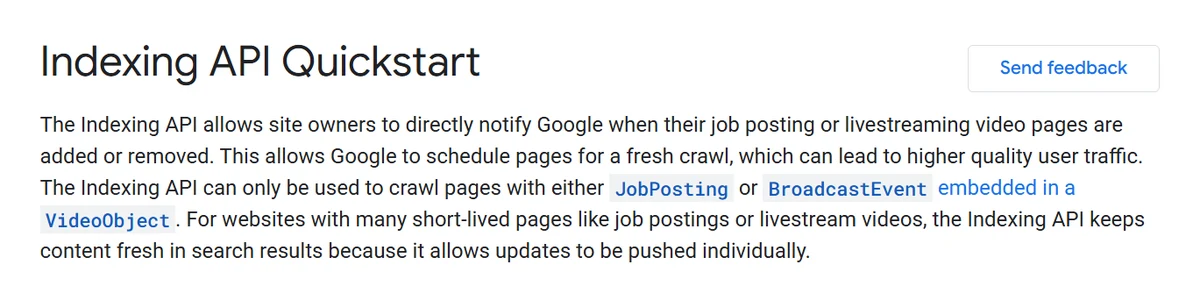
For those two page types, it works exactly as advertised, and you should use it. Each service account can submit up to 200 URLs a day, submissions are processed in minutes, and removals are honoured fast.
Why it used to work on pages it was never meant for
Here is the loophole the entire off-label market was built on: Google can only verify what type a page is after processing it. So a submission for a plain product page or blog post was accepted at the door, and the crawl it triggered usually happened regardless. The page got fetched fast, and if it was indexable on its merits, it often indexed fast too.
That is the past tense on purpose. The mechanism was never the problem; the dependency was, and in 2026 the dependency came due.
What changed in 2025 and 2026
First, the correction, because the internet is currently full of the opposite claim: Google has not discontinued the Indexing API. It is live and documented as I write this in July 2026, and for job postings and livestream video pages it still does its job. Anyone telling you the API was shut down is wrong, and anyone selling you a replacement on that basis is selling on a false premise.
What actually changed is enforcement, in three steps.
The documentation now carries an explicit abuse warning. Google’s own quickstart states that all submissions through the Indexing API undergo rigorous spam detection, and that any attempts to abuse it, “including the use of multiple accounts or other means to exceed usage quotas”, may result in access being revoked. Read that second clause again, because it describes the standard architecture of every autopilot indexing service: multiple service accounts across multiple projects, stacked to get past the 200-a-day ceiling. Google did not name those services. It did not need to.
Access to the jobs side was narrowed during 2025. Multiple industry reports describe Google restricting direct API access toward approved partners and adding an access-request step, where previously a service account could start submitting immediately. Legitimate job boards felt this first, which is worth noticing: the tightening was not aimed only at the off-label crowd.
From late May 2026, off-label submissions widely stopped landing. This is the change that emptied the market, and the failure mode is the part worth understanding. Reports describe requests still returning 200 OK, quota still being consumed, and Googlebot simply never arriving. Nothing errors. Nothing warns you. A dashboard built on those responses keeps showing green while delivering nothing. I am attributing this one carefully, because a lot of the loudest write-ups come from vendors selling an alternative, and I have not audited anyone else’s data. What is not in dispute is the outcome: INDEXED.pro, a polished autopilot submitter with a real customer base, now serves a notice telling customers the service was discontinued “due to Google’s recent Indexing API changes”, subscriptions cancelled.
That is the whole risk model in one sentence: the endpoint kept answering, the results stopped coming, and the product died anyway.
Where that leaves the API today
Google narrowed the API back to the job it was built for. In practice, as of July 2026:
- It works for pages carrying
JobPostingstructured data, and for live video events carryingBroadcastEventinside aVideoObject. Both are page types that expire, which is the entire reason a push channel exists for them: a job that closed or a stream that ended needs to leave the index today, not next crawl. - It does not work as a general indexing shortcut. Ordinary pages, product pages, blog posts, category pages and location pages get nothing from it. Submitting them is not a faster route to the index; it is a request that consumes quota and produces no crawl.
- Even on the eligible page types, access is no longer automatic. The jobs side was gated toward approved access during 2025, so a service account that worked years ago may need re-approval.
If your site is a shop, a blog, a local business or anything else without those two schema types, the honest summary is that this API was never for you, and it is no longer even accidentally useful to you.
The actual risk, stated plainly
I will not tell you the API will burn your site down, because I have not seen that happen. Here is what I have seen and what Google’s own position supports:
It is tolerated behaviour, not supported behaviour. Using the API outside its documented page types has always been outside the guidelines, and the documentation now says plainly that submissions face spam detection and that quota-stacking can cost you access. Nothing you build on it comes with any commitment from Google.
Loopholes in this niche close without notice, and 2026 proved it. The pattern is familiar: a submission trick spreads, gets abused at scale, and Google narrows it. What the last year added is the evidence. Workflows leaning on the off-label path stopped producing crawls, an established service shut down and cancelled its subscriptions, and the sites that never fixed their underlying indexing problems ended up exactly where they started, minus the subscription fees.
Silent failure is worse than an error. A 403 tells you to stop. A 200 that quietly does nothing lets you keep paying, keep reporting success upward, and lose months before anyone checks whether the pages actually entered the index. If you run any submission tooling, verify outcomes independently, in Search Console or with a bulk index checker, and never treat a submission receipt as evidence of indexing.
Fast crawling never overrode a quality decision. This is the part the sales pages skip. If your pages sit at crawled, currently not indexed, Google has already fetched them and declined. The API triggers another fetch. It does not change the decision, because the decision was never about the queue.
What to do instead, in four steps
- If your pages genuinely carry JobPosting or BroadcastEvent structured data, use the API as documented and stay inside the 200 URLs per day per service account.
- For everything else, keep a clean sitemap submitted in Search Console. It is the channel Google actually documents for normal pages.
- For the handful of pages that matter this week, press Request Indexing yourself rather than paying a wrapper to spend your quota on a dead endpoint.
- Before either, check where the pages actually stand. A page Google crawled and declined needs a fix, and the status hub tells you which one.
If your problem is rejection, meaning pages crawled but not indexed, no submission channel fixes that, official or otherwise. The cause is on the page or in the site’s signals, and it needs a diagnosis, not another submission. That diagnosis is the first step of every indexing job I run, it is free, and it ends with the cause in plain English so you can decide what to do about it.
The honest summary: the Indexing API is a good tool being sold as a shortcut. Use it for what it is for. For everything else, the slow boring route through Search Console is slower, boring, and the only one Google has promised to keep open.
Quick answers
Has Google discontinued the Indexing API?
No. The API is live and documented as of July 2026, and it still works for the two page types it was built for. What changed is enforcement: access to the jobs side was narrowed, the documentation now warns that submissions undergo rigorous spam detection and that using multiple accounts to exceed quota can get access revoked, and from late May 2026 there were widespread reports that off-label submissions stopped producing crawls. The API did not die. The loophole did.
Why is the Google Indexing API not working in 2026?
If you are submitting job posting or livestream pages and getting errors, check whether your project still has approved access, since that side was tightened. If you are submitting normal pages, nothing is broken from Google's point of view: you are using an endpoint outside its documented purpose, and Google has been enforcing that. The reported failure mode is the dangerous part, because requests return 200 OK and consume quota while no crawl follows.
Can I use the Google Indexing API for a normal website?
Technically the endpoint accepts the request. Officially no: Google documents the API for JobPosting and BroadcastEvent pages only, and its own documentation now warns that submissions face rigorous spam detection. Treating it as a general indexing shortcut is building on something Google has already started to enforce against.
Will using the Indexing API get my site penalized?
There is no documented penalty for it, and I have not seen a manual action caused by API submission alone. The realistic risks are quieter: submissions getting ignored, API access being revoked, and spam-heavy usage patterns adding to the signals around a site. The cost is fragility, not a penalty letter.
Why do indexing services use the API if it is off-label?
Because it is fast, cheap to operate, and easy to sell. A service account pushes 200 URLs a day per project with no human work. When it stops working, the service loses nothing; you were the one whose workflow depended on it.
What should I use instead of the Indexing API?
For pages you control: fix whatever keeps them out of the index, then request indexing in Search Console, the one channel Google actually provides. Sitemaps plus internal links handle discovery at scale. The API remains the right tool for the two page types it officially supports.