On an established site with no blockers, a new page indexes within hours to a few days. Pages with a fixed blocker take from the same day to a few weeks. Large catalogue backlogs take weeks to months. Those are records, not estimates.
I track indexing for a living, URL by URL with dates, across more than 8,500 tracked URLs on 740+ client sites since 2023. Here is the same question answered from those records instead of theory.
The short answer
On an established site in good standing, a new page typically indexes within hours to a few days. On a brand-new website, the first pages usually take two to four weeks, and the rest arrive in waves. A page held back by a quality or technical problem does not index on any timeline until the cause is fixed.
What I actually see
Established sites that already index well: new pages typically appear within days. Sometimes within hours of a manual submission. This is the healthy baseline, and if your site is here you rarely need anyone like me.
New domains with no history: weeks is normal. Google has no reason to trust a site it just met, so it samples slowly. A brand-new site with clean technicals should not panic before the one-month mark.
Sites with a fixed problem: this is my daily work, and the range is honestly wide. I have watched a page flip to indexed the same day its blocker was removed. One full 63-page site was completely indexed about two weeks after the job started. Both are normal outcomes of the same process.
Large catalogues clearing a backlog: weeks to months, moving in waves. One store needed over a thousand submissions across 118 days of daily work. The queue drains, but it drains on Google’s schedule, a slice at a time. And on catalogues, the door swings both ways: indexed pages drift back out over time, which is why the biggest stores run on monthly plans instead of one-time pushes.
The same records as a table, to check your own situation against:
| Starting point | Typical time to indexed | From the records |
|---|---|---|
| Established site that already indexes well | Hours to days | Manual submissions often land within days |
| New domain with no history | Weeks | No cause for panic before the one-month mark |
| Page with a fixed blocker | Same day to a few weeks | One 63-page site fully indexed in about two weeks |
| Large catalogue clearing a backlog | Weeks to months, in waves | Over a thousand submissions across 118 days on one store |
What actually controls the speed?
Four things, roughly in order of weight.
Your site’s standing with Google. Sites that have historically served substantial, original pages get crawled often and indexed fast. Sites with a history of thin pages get sampled cautiously. This is why the same page indexes in a day on one domain and a month on another.
How the page gets discovered. A page linked from your homepage and submitted in a clean sitemap enters the queue near the front. An orphan URL sitting only in a sitemap enters at the back, and often shows up as Discovered, currently not indexed for weeks.
Whether the page clears the quality bar. Google can crawl a page quickly and still decline to store it. That is Crawled, currently not indexed, and no amount of waiting fixes it, because the page, not the clock, is the problem.
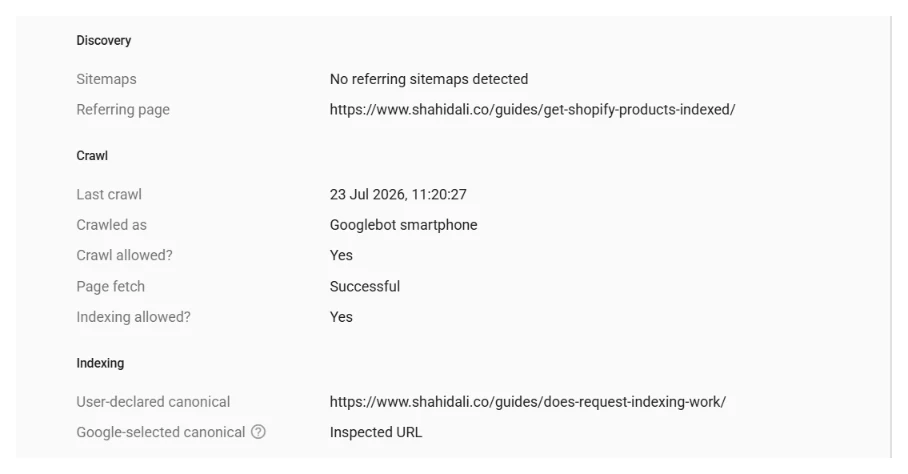
Technical blocks. A noindex tag or a robots rule stops the clock entirely. The page will not index in a day or a year. If a page has waited a long time, rule this out first with URL Inspection; the causes are in my guide to pages missing from Google.
What legitimately speeds it up?
Submit a clean sitemap and keep it current. Link new pages from pages Google already visits often, because your internal links are the crawl priority list. Fix whatever cause is holding the site’s standing down. And for the pages that matter commercially, request indexing by hand in Search Console, one URL at a time, and track what happens.
What does not speed it up: pressing Request Indexing daily on an unchanged page, and indexing bots or automated submission tools. The bots violate Google’s guidelines, most stopped working after Google tightened the API, and the risk lands on your site, not on the tool seller.
What to do while you wait, in four steps
- Confirm the page is in a submitted sitemap and is linked from at least one page Google already indexes. Discovery is the step most slow pages are actually stuck on.
- Inspect the URL in Search Console. If it still reads as unknown to Google after a week, press Request Indexing once and stop pressing.
- If it reads as crawled but not indexed, stop waiting. Google has seen it and declined it, and that has a cause to fix, not a timer to run out.
- If you have more than a handful of pages, check them all in one pass instead of inspecting one at a time, and read what each status means before you act on it.
When a long wait means something is wrong
Waiting is only ever the answer when nothing is blocking and nothing is deficient. My working rule from client sites: an important page on an established site that shows no movement after two to three weeks has a cause, not a queue position. At that point someone should open Search Console and name it, because the wait will not end on its own.
That diagnosis is what I do first on every indexing job, and it is free before you commit to anything. Every job after that runs on a per-URL ledger: indexed, pending, or fixed, with dates, so the timeline stops being a mystery and becomes a record you can check. The results of that approach are public in the case studies.
Send me your website and I will tell you whether you are waiting on a queue or waiting on a problem, usually within a day. No obligation.
Quick answers
How long does it take Google to index a new website?
Weeks is the honest norm. A brand-new domain has no crawl history, so Google samples it slowly; the first pages often appear inside the first two to four weeks and the rest follow in waves. Clean technicals, a submitted sitemap, and real internal links shorten the wait. If nothing has indexed after a month, stop waiting and look for a blocker.
Can I make Google index my pages faster?
You can remove what slows it down: submit the sitemap, link the page from pages Google already visits, and inspect and submit the URL by hand in Search Console. What you cannot do is force the decision; speed follows the site's crawl history. The order that works on client sites: rule out blocks first, then the sitemap, then internal links from the pages Google crawls most, and spend the manual submissions on the commercially important URLs. Submissions without fixes underneath them change nothing, which is why the button alone has such a mixed reputation.
Why do some pages index in hours and others take weeks?
The difference is trust and discovery. A page linked from a frequently crawled page on an established site gets fetched fast. A page deep in a new site with thin internal links waits until Google finds a reason to visit.